Loading…
Blog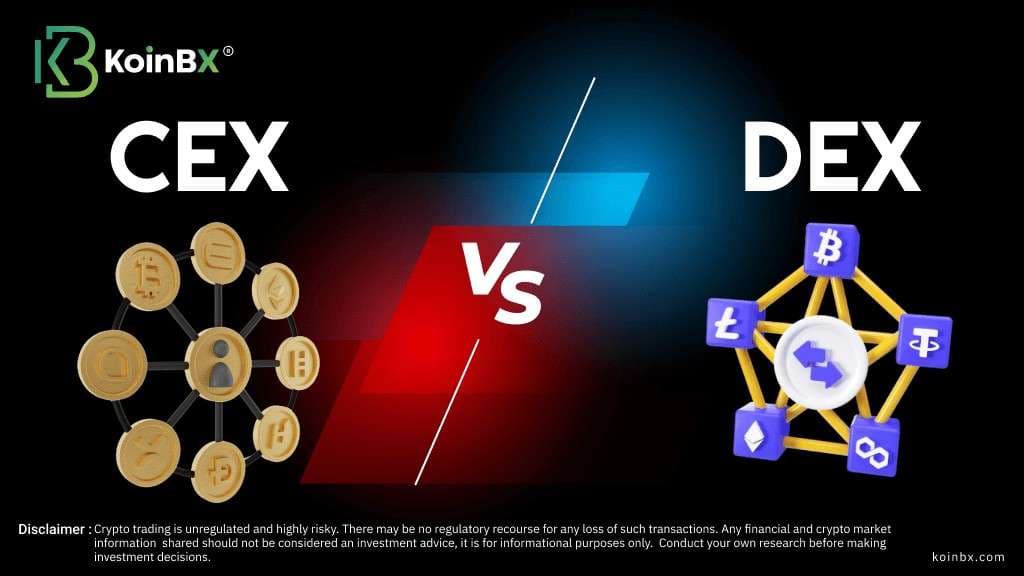
Centralized Exchanges vs. Decentralized Exchanges: Understanding the difference
26/02/2025, 10:44:07 am
Article Content
Introduction
Exploring the crypto world often leads to encountering decentralized exchanges (DEXs). Whether you're currently using a centralized exchange (CEX) like KoinBX and contemplating a shift to a DEX, or you're in pursuit of the latest DeFi token not yet available on CEXs, understanding the differences between these exchange types is crucial.
CEXs offer a secure environment for trading crypto assets, whereas DEXs present higher risks. To navigate this choice effectively, it's essential to grasp the distinct characteristics of each. This article dives into the key differences between centralized and decentralized exchanges, empowering you to make an informed decision aligned with your goals and experience level.
What is a Centralized Exchange (CEX) and How Does It Work?
Centralized exchanges are platforms that operate under a single authority, managing users' funds and executing trades on their behalf. They function similarly to traditional stock exchanges, where transactions are facilitated through a central entity.
CEXs maintain custody of users' funds, requiring them to create accounts and undergo verification processes. Trading occurs on a centralized order book managed by the exchange, which matches buy and sell orders based on market conditions.
|
Pros of Centralized Exchange |
Cons of Centralized Exchange |
|
User-friendly interface and simple platforms |
Highly vulnerable to hacking or cybersecurity threats |
|
An added layer of security and trustworthiness |
Charges service fees |
You can also read : Crypto staking vs Crypto restaking
What is a Decentralized Exchange (DEX) and How Does It Work?
Decentralized exchanges operate without a central authority or intermediary. They facilitate peer-to-peer trading of crypto assets directly between users, leveraging blockchain to execute transactions securely and transparently.
DEXs use smart contracts to automate the matching and execution of trades, eliminating the need for a central order book. Users retain control of their funds through decentralized wallets, interacting with the exchange's protocol to trade directly with other participants.
|
Pros of Decentralized Exchange |
Cons of Decentralized Exchange |
|
Completely private and anonymous |
Trading in fiat currency is not permitted |
|
No need to transfer assets to a third party |
Risk of impermanent loss for liquidity providers |
|
Fees are redistributed to liquidity providers, not to a centralized entity |
Liquidity can be thin, making it harder to execute large orders |
You can also read : HODL vs Staking
Decentralized Exchange Vs Centralized Exchange
|
Feature |
Centralized Exchange |
Decentralized Exchange |
|
Ease of use |
Typically user-friendly interfaces |
Can have a learning curve with decentralized wallets |
|
Security |
Centralized security measures; risk of hacks and data breaches |
Relies on blockchain security; users control their private keys |
|
Features |
Offers advanced trading tools and order types |
Focuses on decentralized trading and liquidity provision |
|
Speed |
Generally faster execution due to centralized servers |
Transactions depend on blockchain confirmation times |
|
Fees |
Charges transaction fees, varying by platform |
Often lower fees; may involve gas fees for transactions |
|
Trading volume |
Handles high trading volumes efficiently |
Can struggle with high-volume trades due to liquidity issues |
|
Liquidity |
High liquidity, especially for major cryptocurrencies |
Liquidity can vary; may be lower for less popular tokens |
|
Regulations |
Subject to regulatory compliance and oversight |
Operates independently with less regulatory scrutiny |
|
Fiat payment |
Supports trading with fiat currencies |
Primarily focuses on crypto-to-crypto trading |
You can alos read : Market order vs limit order
Should I Use a DEX or a CEX?
For those just starting out with crypto, the easiest way to get involved is by using a CEX. It simplifies the learning process that comes with understanding decentralized blockchain. If you encounter any problems with a CEX, there will be a dedicated support team ready to assist and guide you through it.
In general, the risk of making a mistake that's hard to undo, such as losing access to your funds or sending them to the wrong recipient, is significantly reduced when using a CEX. Therefore, if you're new to the crypto world or prefer a service that's easy to understand and use, a CEX is a great choice.
On the flip side, a DEX serves as a perfect entry point into the DeFi space. With just one Ethereum Virtual Machine (EVM) wallet, you can dive into the vast DeFi landscape. EVM is a decentralized computing environment that runs smart contracts on the Ethereum blockchain. A DEX is a flexible choice for experienced crypto users and provides a lot of autonomy.
If you're interested in investing in a wide variety of new projects, especially those with smaller market caps, a DEX is also a choice. While CEXs are known for launching new tokens, DEXs are involved in most new token offerings and provide a lot of liquidity.
Final Thoughts
To sum up, the decision between a CEX or a DEX hinges on what you're looking for in a trading platform and what you prefer. For beginners, a CEX could be the way to go because it's simpler to use and offers more trading opportunities. On the other hand, if privacy is a top priority, a DEX could be a better choice due to its decentralized nature and enhanced privacy features. It's crucial to take into account the elements mentioned in this piece, including security, trading opportunities, transaction costs, ease of use, and transaction speed, when selecting an exchange. In the end, the exchange you pick should align with your trading goals and offer the essential features and functionalities for a smooth trading journey.
Download KoinBX Android App | Download KoinBX iOS App
Disclaimer: Any financial and crypto market information shared should not be considered investment advice. It is for informational purposes only. Conduct your own research before making investment decisions. Crypto trading is unregulated and highly risky. There may be no regulatory recourse for any loss of such transactions.
Share Post
Share this article with your friends and community!