Loading…
Blog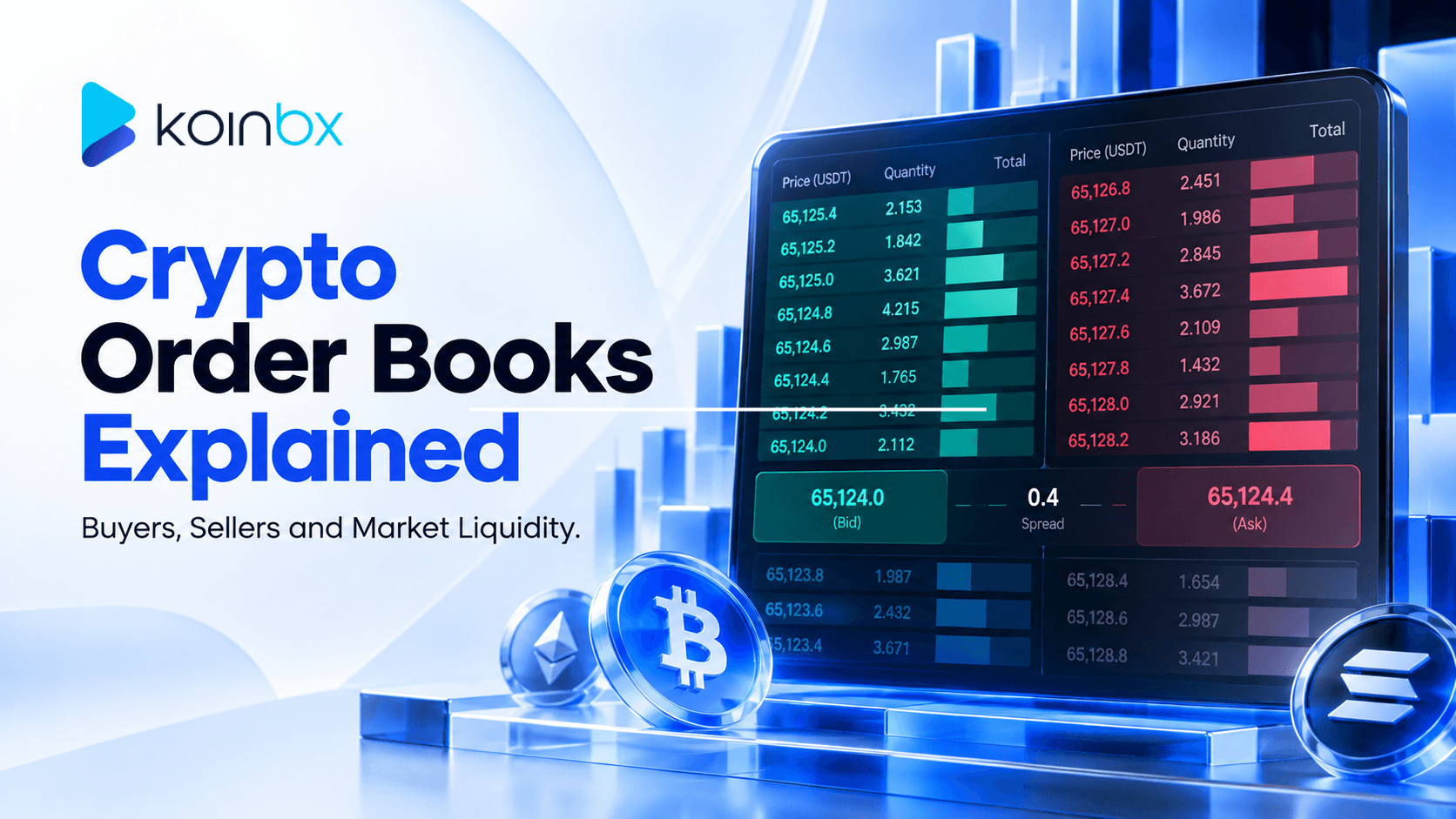
Crypto Order Books: A Beginner’s Guide to Bids, Asks and Market Depth
12/10/2026, 11:50:39 am
Article Content
Crypto Order Books Explained: How Buyers, Sellers and Liquidity Shape Prices
Introduction
Every cryptocurrency trade involves a buyer and a seller. But how do their orders come together, and how does the market determine the price at which a trade happens?
One important part of this process is the order book. It displays the buy and sell orders waiting to be matched on a trading platform. By examining an order book, traders can understand the current supply and demand at different price levels, observe the gap between buying and selling prices, and assess the liquidity available in a particular trading pair.
Understanding order books can help traders make more informed decisions, whether they are buying cryptocurrency, selling an asset, or exploring short-term trading strategies.
1. What Is a Crypto Order Book?
A crypto order book is a real-time list of open buy and sell orders for a particular trading pair on an exchange.
It generally contains two sides:
Buy orders (bids): Orders placed by traders who want to buy an asset at a specified price.
Sell orders (asks): Orders placed by traders who want to sell an asset at a specified price.
For example, consider a hypothetical BTC/USDT order book. Some traders may want to buy Bitcoin at $60,000, while others may be willing to sell at $60,100.
These orders remain in the order book until they are filled, cancelled, or otherwise removed according to the exchange's rules.
An order book is constantly changing as new orders arrive, existing orders are modified or cancelled, and trades are executed. It provides a snapshot of available orders at a particular moment rather than a guarantee of future market activity.
2. How Does a Crypto Order Book Work?
When a trader places a limit order, the order specifies the maximum price they are willing to pay when buying or the minimum price they are willing to accept when selling.
If the order cannot be matched immediately, it may rest in the order book.
Market orders work differently. A market buy generally matches with available sell orders, while a market sell generally matches with available buy orders. The final execution price depends on the available liquidity and the quantity being traded.
Consider this simplified example:
| Buy orders (Bids) | Quantity (BTC) | Sell orders (Asks) | Quantity (BTC) |
| $60,000 | 1.5 | $60,100 | 1.0 |
| $59,900 | 2.0 | $60,200 | 2.5 |
| $59,800 | 3.0 | $60,300 | 1.8 |
In this example, the highest displayed bid is $60,000, while the lowest displayed ask is $60,100.
A market buy that consumes the available sell order at $60,100 may execute at that price, provided sufficient quantity is available there. A larger market buy may also consume sell orders at higher prices.
Likewise, a market sell can match with buy orders at the highest available bid and may continue to lower bids if its quantity exceeds the liquidity at the best price.
This is one way order-book activity can influence the prices at which trades execute.
3. Understanding Bids, Asks and the Spread
Three key terms help explain the structure of an order book.
Best Bid
The best bid is the highest price currently offered by a buyer in the order book.
Best Ask
The best ask, also called the best offer, is the lowest price currently requested by a seller.
Bid-Ask Spread
The bid-ask spread is the difference between the best ask and the best bid.
Using the example above:
- Best bid: $60,000
- Best ask: $60,100
- Spread: $100
The spread can also be expressed as a percentage of the midpoint between the best bid and ask. In this example, the spread is approximately 0.167% of the midpoint price.
A narrower spread often indicates that buyers and sellers are willing to trade at relatively close prices. A wider spread may indicate lower liquidity, greater uncertainty, or less competition among available orders.
However, spread alone does not provide a complete picture of market liquidity. The amount available at each price and the cost of executing a particular trade also matter.
4. What Is Market Depth?
Market depth refers to the quantity of buy and sell orders available at different prices in an order book.
A market with substantial orders across several nearby price levels is generally better positioned to absorb larger trades without significant price changes than a market with limited orders. This depends on the orders remaining available when the trade is executed.
For example, imagine two trading pairs:
Market A: Several buy and sell orders are available near the current price.
Market B: Only small quantities are available near the current price, with larger gaps between price levels.
A large market order may have a smaller price impact in Market A. In Market B, it may consume the limited orders near the current price and continue executing at less favourable prices.
This is why market depth is important when assessing how easily an asset can be traded.
5. How Do Order Books Affect Crypto Prices?
Order books help show the prices at which traders are currently willing to buy and sell. Their structure can influence execution prices, especially when market orders consume available liquidity.
Here are four important ways order-book activity matters.
1. Buying Pressure
When aggressive buyers submit market orders, they consume available sell orders. If they exhaust the quantity offered at the lowest ask, subsequent purchases may execute at higher prices.
This can push the execution price upward, particularly when there is limited sell-side liquidity.
2. Selling Pressure
When aggressive sellers submit market orders, they consume available buy orders. If the quantity at the highest bid is insufficient, additional selling may execute at lower bid prices.
This can push the execution price downward when available buy-side liquidity is limited.
3. Liquidity Gaps
A liquidity gap occurs when relatively little order quantity is available across a range of prices.
If a market order moves through such a gap, the execution price can change more sharply than it would in a market with deeper liquidity.
4. Order Placement and Cancellation
Traders can add or cancel limit orders as their expectations change. As a result, displayed liquidity can appear or disappear quickly.
Large orders visible in an order book may attract attention, but they do not guarantee that the market will move in a particular direction. Orders can be cancelled before execution, and new orders can arrive at any time.
An order book therefore shows current intentions to trade, not a reliable prediction of future prices.
6. What Are Buy Walls and Sell Walls?
A buy wall is a large concentration of buy orders at or near a particular price level. A sell wall is a large concentration of sell orders at or near a particular price level.
Buy Wall
A large buy wall may suggest that substantial buying interest is displayed at a specific price. Traders may interpret it as a potential area of support because sell orders reaching that price could encounter significant displayed demand.
However, the orders may be cancelled, and aggressive selling can still consume them. A buy wall is not guaranteed support.
Sell Wall
A large sell wall may indicate substantial displayed selling interest at a particular price. Traders may interpret it as a potential area of resistance because buyers may need to absorb that supply before trading at higher prices.
But a sell wall is not guaranteed resistance. The orders may be removed, or strong buying activity may consume them.
Important: Buy walls and sell walls should be treated as observations, not automatic trading signals. Their significance depends on whether the orders remain available, how trades interact with them, and the broader market context.
7. What Is Order Book Imbalance?
Order book imbalance describes a difference between the displayed quantity of buy orders and sell orders across selected price levels.
For example, if the order book shows substantially more buy-side quantity than sell-side quantity near the current price, the displayed book may have a buy-side imbalance.
Some traders use this information to understand short-term market conditions. However, a displayed imbalance does not necessarily mean the price will rise.
The visible orders may be cancelled or changed, and the calculation may include only a selected portion of the order book. Actual trades, liquidity changes, and orders outside the visible range can also affect the market.
Order book imbalance is therefore best considered alongside executed trades, price action, volume, and other relevant information.
8. Order Book vs. Trade History: What Is the Difference?
Order books and trade history provide different types of information.
| FeatureOrder BookTrade History | ||
| What it shows | Current open buy and sell orders | Trades that have already been executed |
| Main information | Displayed prices and available quantities | Execution prices, quantities and timestamps |
| How it changes | Orders are added, modified, filled or cancelled | New completed trades are recorded |
| What it helps assess | Available liquidity and potential execution costs | Actual trading activity and recent transactions |
The order book shows what traders are currently offering or requesting, while trade history records what has actually traded.
Using both can provide a more complete view of market activity. Neither can reliably predict future price movements on its own.
9. How to Read an Order Book Before Placing a Trade
A practical approach can help traders interpret the order book without relying on individual signals.
Step 1: Check the best bid and ask. Understand the current spread before placing an order.
Step 2: Review nearby market depth. Examine the quantity available at several price levels on both sides of the book.
Step 3: Consider your order size. A trade that is large relative to available liquidity may execute across multiple price levels.
Step 4: Choose the appropriate order type. A limit order gives you control over the specified price, but execution is not guaranteed. A market order prioritises execution against available liquidity, but the final price may differ from the price initially displayed.
Step 5: Observe changes carefully. Watch whether displayed orders remain available and how actual trades interact with them. Avoid interpreting a single large order as proof of market direction.
Step 6: Review fees and execution risk. Trading fees, spread, slippage and the amount available at each price can all affect the effective cost of a trade.
For larger orders, traders may consider splitting an order into smaller portions, depending on their strategy and the market conditions. This can affect execution, but it does not eliminate price impact or guarantee a better result.
10. Common Mistakes to Avoid When Reading Order Books
Assuming Large Orders Cannot Be Overcome
A large displayed order can be filled, reduced, or cancelled. It does not guarantee that a price level will hold.
Ignoring the Spread
A trader may focus on the displayed market price without considering the difference between the best bid and ask. That difference can affect the cost of entering or exiting a position.
Confusing Displayed Orders With Completed Trades
An order shown in the book has not necessarily been executed. Trade history is needed to examine completed transactions.
Ignoring Slippage
Slippage occurs when the execution price differs from the expected price. It can happen when available liquidity is insufficient, prices move quickly, or orders are matched across several price levels.
Treating the Order Book as a Price Prediction Tool
An order book shows visible orders at a particular time. It cannot account for every future order, cancellation, market event, or change in sentiment. It should support analysis rather than replace risk management and independent judgment.
Conclusion
A crypto order book is an important tool for understanding how buy and sell orders interact on an exchange. By examining bids, asks, the bid-ask spread, market depth, and displayed order imbalances, traders can better understand available liquidity and the potential cost of executing a trade.
However, order books change continuously, and displayed orders do not guarantee future market behaviour. Combining order-book information with trade history, price action, volume, and disciplined risk management provides a more balanced approach to analysing cryptocurrency markets.
Explore cryptocurrency markets on KoinBX: https://koinbx.com/
Terms & Conditions
By accessing or using KoinBX services, you agree to comply with KoinBX’s applicable Terms & Conditions, policies, eligibility requirements and product-specific terms. Product availability, features, fees and conditions may vary by jurisdiction and may be subject to change.
Risk Disclaimer
Crypto assets and crypto-related products are highly volatile and involve significant risk. Futures and leveraged trading can result in substantial losses, including loss of your entire invested capital. Please assess your risk tolerance, understand the product and applicable terms, and trade responsibly. Do not invest or trade more than you can afford to lose.
Share Post
Share this article with your friends and community!