Loading…
Blog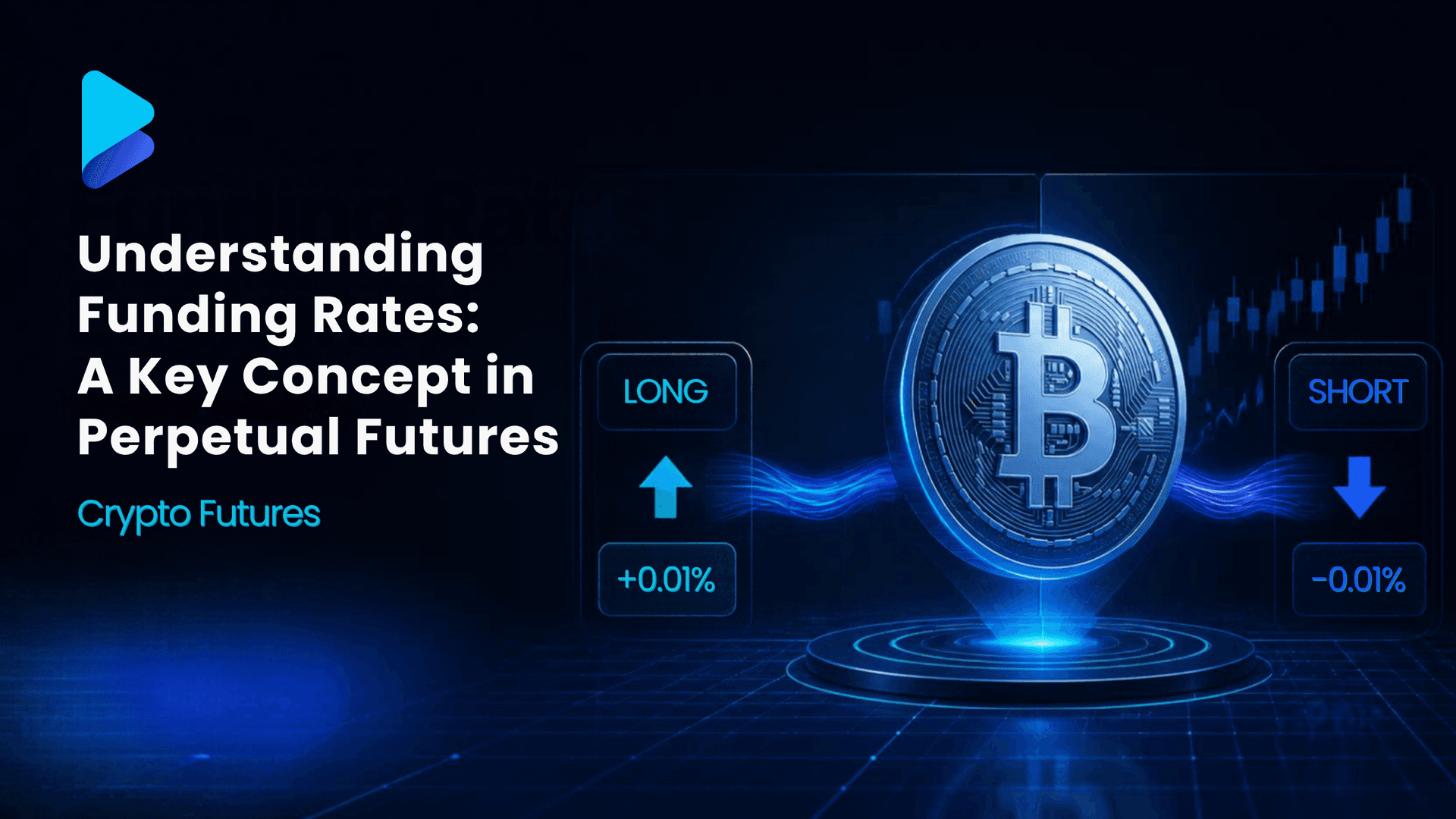
Funding Rates Explained: A Guide to Crypto Futures
06/10/2026, 07:06:32 am
Article Content
Funding Rates Explained: What Crypto Futures Traders Need to Know
When trading crypto perpetual Futures, traders often focus on price, leverage, entry points and profit and loss.
But there is another important factor that can affect the cost of holding a position: the funding rate.
If you trade perpetual Futures, understanding funding rates can help you better understand the cost of keeping positions open, market positioning and the relationship between Futures prices and the underlying spot market.
What Is a Funding Rate?
A funding rate is a periodic payment exchanged between traders holding long and short positions in a perpetual Futures contract.
Unlike traditional Futures contracts, perpetual Futures do not have a fixed expiration date. Because there is no expiry forcing the Futures price to converge with the spot price, perpetual contracts use a funding mechanism to help keep their price aligned with the underlying asset's spot or index price.
The important point is that funding is generally paid between traders rather than being a simple trading fee charged by the exchange.
Positive vs Negative Funding Rates
The direction of the funding rate determines which side generally pays.
Positive Funding Rate
When the funding rate is positive:
Longs pay shorts.
A positive rate can occur when the perpetual Futures market is trading above the underlying spot or index price, often reflecting stronger demand for long positions.
For example, suppose:
Position: Long
Position value: $10,000
Funding rate: +0.01%
The funding amount would be approximately:
$10,000 × 0.01% = $1
So, under a simple funding calculation, the long would pay approximately $1 for that funding period.
The actual amount depends on the contract's funding methodology and the position value used by the platform.
Negative Funding Rate
When the funding rate is negative:
Shorts pay longs.
This can happen when the perpetual Futures price is below the underlying spot or index price and short positioning is relatively stronger.
For example:
Position: Short
Position value: $10,000
Funding rate: -0.01%
The short would pay approximately:
$10,000 × 0.01% = $1
Again, this is an illustrative example. Actual funding calculations vary by platform and contract.
Why Do Funding Rates Exist?
The main purpose of funding is to help keep perpetual Futures prices close to the underlying spot or index price.
Imagine that Bitcoin is trading at $100,000 in the spot market while its perpetual Futures price moves significantly higher because demand for long positions increases.
A positive funding rate can make holding a long position more expensive because longs pay funding to shorts.
This creates an economic incentive for traders on the short side and can help bring the perpetual Futures price closer to the underlying market price.
The reverse can happen when the perpetual Futures price trades below the underlying index price. A negative funding rate can result in shorts paying longs.
Does a High Funding Rate Mean Bitcoin Will Go Up?
Not necessarily.
This is one of the most important things traders should understand.
A high positive funding rate generally tells you that the cost of holding long positions is elevated relative to the other side.
It does not guarantee that the asset will continue rising.
Similarly, a negative funding rate does not automatically mean that the asset will fall.
Funding rates provide information about the current relationship between perpetual Futures positioning and the underlying market. They should be considered alongside other factors such as price structure, volume, open interest, volatility and broader market conditions.
Funding Rate vs Trading Fee
Funding and trading fees are not the same thing.
Trading Fee
A trading fee is associated with executing an order and is determined by the platform's fee structure.
Funding Payment
A funding payment is a periodic transfer between long and short positions in a perpetual Futures market.
This means a trader can have a profitable position based on price movement while still paying funding during periods when their side of the market is required to pay.
Conversely, a trader can receive funding while holding a position, depending on the funding rate and their position direction.
How Does Funding Affect Your P&L?
Consider a trader who holds a $20,000 long position.
Suppose the applicable funding rate is:
+0.02%
A simple calculation gives:
$20,000 × 0.02% = $4
If the trader is required to pay funding for that period, the position would incur approximately $4 in funding.
If the trader continues holding the position through several funding periods, these amounts can accumulate.
This is why traders holding perpetual positions for longer periods should pay attention to funding rather than looking only at entry price and unrealized P&L.
Funding Rates Can Change
Funding rates are not necessarily fixed.
They can change as market conditions and the relationship between the perpetual Futures price and the underlying spot or index price change.
For example:
Strong demand for longs → funding may become positive
Strong demand for shorts → funding may become negative
The exact calculation, interval and methodology depend on the exchange and specific contract. For example, some venues calculate funding hourly, while other perpetual products can use different intervals.
Therefore, traders should always check the funding information provided for the specific contract they are trading.
Should You Avoid Trading When Funding Is High?
Not necessarily.
A high funding rate is information, not automatically a trading signal.
Instead of simply thinking:
High funding = Don't go long
it can be more useful to ask:
Why is funding elevated?
Is the Futures price trading at a premium to the spot market?
Is open interest increasing?
Is the market trending strongly?
Is the funding cost reasonable for my expected holding period?
What happens to my position if the market moves against me?
This approach helps turn funding data into part of a broader trading decision rather than treating it as a standalone signal.
Funding Rate and Market Sentiment
Funding rates can also provide insight into market positioning.
A consistently positive funding rate may indicate that long positioning is strong.
A consistently negative funding rate may indicate stronger demand for short exposure.
However, funding alone cannot tell you exactly what the market will do next.
For example, an asset can maintain positive funding while continuing to rise, or positive funding can remain elevated before a sharp reversal.
That is why funding is best viewed as one piece of market information rather than a prediction tool.
5 Things Futures Traders Should Remember
1. Funding Is Not the Same as a Trading Fee
Funding is a payment mechanism between long and short positions in perpetual Futures.
2. Positive Funding Generally Means Longs Pay Shorts
The opposite generally applies when funding is negative.
3. Funding Can Affect the Cost of Holding a Position
The longer a position remains open, the more relevant recurring funding payments can become.
4. Funding Does Not Predict Price Direction
A positive or negative funding rate should not be treated as a guaranteed bullish or bearish signal.
5. Always Check the Contract Details
A Simple Funding Rate Checklist
Before holding a perpetual Futures position, consider checking:
Funding Rate: Is it positive or negative?
Position Direction: Are you long or short?
Position Size: How much notional exposure are you carrying?
Holding Period: How long do you expect to keep the position open?
Market Conditions: What are price, volume and volatility doing?
Risk: How much could you lose if the market moves against your position?
Understanding these factors can help you make more informed Futures trading decisions.
Final Thoughts
Funding rates are an essential part of understanding perpetual Futures.
They help connect the perpetual Futures market with the underlying spot market while creating a periodic payment mechanism between traders on opposite sides of the market.
For traders, the key is not simply to look at whether funding is positive or negative. The more important question is what the funding rate is telling you about the current market and how it affects the cost and risk of your position.
The better you understand these mechanics, the better prepared you are to navigate perpetual Futures markets.
Trade with knowledge. Understand the mechanics. Manage your risk.
Terms & Conditions
By accessing or using KoinBX services, you agree to comply with KoinBX’s applicable Terms & Conditions, policies, eligibility requirements and product-specific terms. Product availability, features, fees and conditions may vary by jurisdiction and may be subject to change.
Risk Disclaimer
Crypto assets and crypto-related products are highly volatile and involve significant risk. Futures and leveraged trading can result in substantial losses, including loss of your entire invested capital. Please assess your risk tolerance, understand the product and applicable terms, and trade responsibly. Do not invest or trade more than you can afford to lose.
Share Post
Share this article with your friends and community!