Loading…
Blog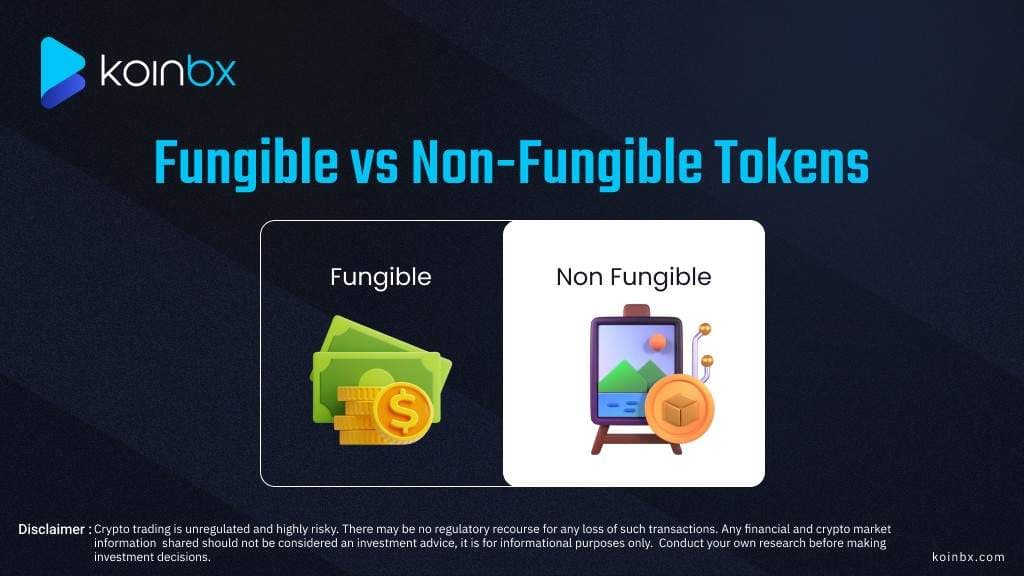
Fungible vs Non-Fungible tokens : Key Differences Explained
07/03/2025, 10:12:06 am
Article Content
The words "fungible" and "non-fungible" might sound like they belong in a science textbook, but these terms are shaping the future of digital finance and ownership. Until recently, you might have only heard these terms in economics classrooms. But with the rise of crypto assets and NFTs (Non-Fungible Tokens), they’ve become buzzwords in the digital world.
During the crypto boom of 2020, people's interest in these terms increased. They were eager to understand the foundation of digital tokens, from Bitcoin to the famous pixelated apes that took the internet by storm.
In this article, we’re diving into the basics of fungible and non-fungible tokens. We’ll break down what these terms mean, and explore their key differences. This guide will help you grasp these essential concepts in the simplest way possible.
What Are Fungible Tokens?
Fungible tokens are digital assets that are interchangeable with one another. Think of them like currency—just as one $10 bill can be swapped for another $10 bill without any change in value, fungible tokens can be exchanged on a one-to-one basis. This interchangeability is their defining feature.
For example, one Bitcoin (BTC) is equivalent to any other Bitcoin in terms of value and usability.
These tokens are also divisible, meaning they can be broken into smaller units. Bitcoin, for instance, can be divided into fractions, such as 0.0001 BTC, allowing for more precise transactions. They are uniform, meaning each unit is identical, and they are highly liquid, making them easy to trade across different platforms such as KoinBX.
Applications Of Fungible Tokens
Fungible tokens have various applications. Crypto assets like Bitcoin and Ethereum are the most well-known examples, serving as digital currencies and stores of value. They are widely used in decentralized finance (DeFi) for lending, staking, and liquidity pools. Stablecoins like Tether (USDT) are another example, offering a stable medium of exchange by being pegged to assets like the US dollar. In gaming, fungible tokens often serve as in-game currencies.
What Are Non-Fungible Tokens (NFTs)?
Non-fungible tokens (NFTs) are the complete opposite of fungible tokens. Unlike their interchangeable counterparts, each NFT is unique and cannot be swapped on a one-to-one basis.
NFTs are indivisible, meaning they cannot be split into smaller units like fungible tokens. You either own an NFT entirely or not at all. Their ownership and transaction history are securely stored on the blockchain, ensuring transparency and authenticity. This feature is particularly important for verifying the provenance of digital assets.
Applications of NFTs
NFTs have gained popularity in various fields. In the art world, artists use NFTs to sell digital creations directly to buyers, retaining royalties from future sales. In gaming, NFTs represent in-game assets like characters or skins that players can own and trade. The metaverse has also embraced NFTs for virtual real estate, allowing users to buy, sell, and develop virtual land. Collectibles, such as rare trading cards or exclusive videos, are another common application. Even musicians and content creators are using NFTs to sell albums, concert tickets, and unique content directly to their fans.
Differences Between Fungible and Non-Fungible Tokens
Feature
Fungible Tokens
Non-Fungible Tokens (NFTs)
| Fungibility | Interchangeable | Unique and cannot be swapped 1:1 |
| Divisibility | Can be divided into smaller units | Indivisible |
| Uniformity | Identical in value and characteristics | Each token has unique attributes |
| Use Cases | Payments, DeFi, gaming currency | Digital art, gaming assets, collectibles |
| Examples | Bitcoin (BTC), Ethereum (ETH) | CryptoPunks, Bored Ape Yacht Club |
In simple terms, fungible tokens are like coins in your pocket; they are all the same. NFTs are like rare collector’s items; each one is different and special.
The Future
Both fungible tokens and NFTs are poised to play significant roles in the digital future. Fungible tokens will likely continue to dominate the financial sector, powering blockchain-based payments, investments, and decentralized finance. They are the backbone of the digital economy, enabling seamless transactions and global financial inclusivity.
NFTs, meanwhile, are expanding their horizons beyond art and gaming. They are being used in industries like fashion, music, and real estate. In the metaverse, NFTs are becoming essential for owning and monetizing virtual spaces. The integration of NFTs with physical assets, such as real estate or luxury items, is another promising avenue. As blockchain evolves, NFTs may redefine how we perceive ownership and value in both the digital and physical worlds
Final Thoughts
Fungible and non-fungible tokens serve unique purposes in the blockchain ecosystem. Fungible tokens provide the foundation for digital transactions and financial operations, while NFTs revolutionize ownership and authenticity in the digital age.
Together, they are transforming how we interact with and value digital assets.
For anyone stepping into the crypto world, understanding these two types of tokens is crucial. Whether you’re trading Bitcoin or exploring NFTs in the metaverse, these tokens offer endless possibilities in the ever-expanding digital landscape.
Download KoinBX Android App | Download KoinBX iOS App
Disclaimer: Any financial and crypto market information shared should not be considered investment advice. It is for informational purposes only. Conduct your own research before making investment decisions. Crypto trading is unregulated and highly risky. There may be no regulatory recourse for any loss of such transactions.
Share Post
Share this article with your friends and community!