Loading…
Blog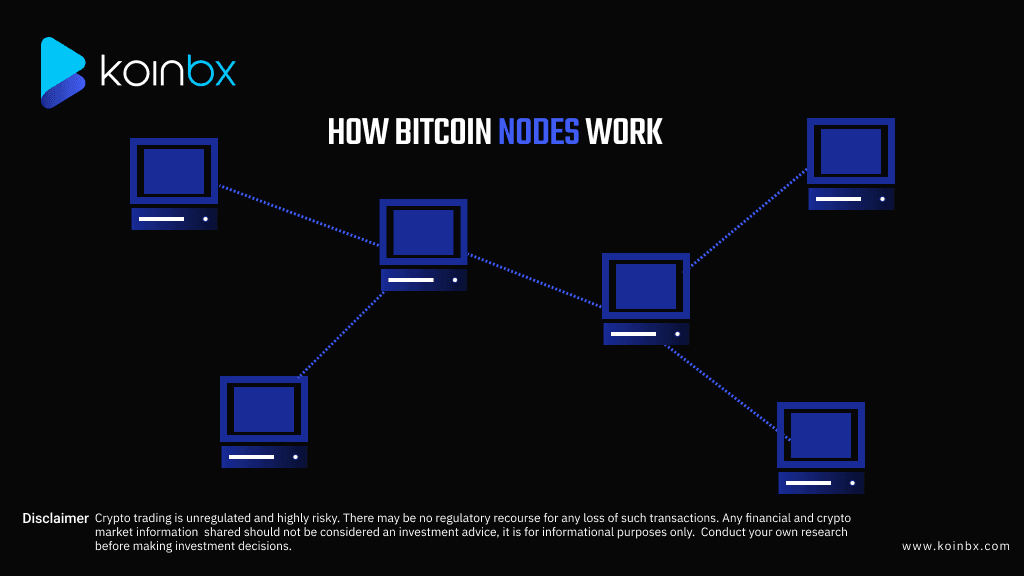
How Bitcoin Blockchain Nodes Work and Why They’re Important
11/07/2025, 07:23:46 am
Article Content
Bitcoin isn’t controlled by one company or government; it’s maintained by a global network of computers called nodes. Think of nodes as the checkpoints and referees of Bitcoin’s world: they verify every transaction, enforce the rules, and pass data along so that everyone agrees on a single, trusted history of payments. Without nodes, Bitcoin would collapse into chaos. In this guide, we’ll explain exactly what a node is, how nodes work together to secure the network, and why running one is one of the best ways to support Bitcoin.
What Is a Node in Bitcoin?
A Bitcoin node is simply any computer that runs Bitcoin’s software and participates in the network. Every node maintains a copy of the blockchain, which is the complete, chronological record of every Bitcoin transaction ever processed. By comparing and sharing this data with other nodes, they collectively ensure that no fraudulent or invalid transactions sneak into the system.
There are three main kinds of nodes, each playing a slightly different role. Full nodes download and store the entire blockchain, now several hundred gigabytes, allowing them to verify every transaction independently and block. Light nodes (also called SPV wallets) only keep the block headers, trusting full nodes to handle the details; this makes them faster and less resource-intensive for everyday use. Mining nodes combine all the duties of a full node with the extra task of solving cryptographic puzzles to produce new blocks and earn Bitcoin rewards. Regardless of type, every node contributes to Bitcoin’s decentralized, tamper-proof design.
What Do Bitcoin Nodes Actually Do?
Nodes perform four critical jobs:
- Verifying Transactions: When you send Bitcoin, your transaction reaches a node. The node checks that you really own the coins (by verifying signatures) and haven’t already spent them.
- Validating Blocks: Each block contains many transactions. Nodes inspect new blocks to ensure they follow rules, correct proof-of-work, no invalid transactions, and a block size under the network limit.
- Enforcing Consensus Rules: Rules like maximum block size, valid scripts, and reward schedules are built into node software. Nodes automatically reject anything that breaks these rules.
- Broadcasting Information: Once a node accepts a valid transaction or block, it forwards it to its peers, other nodes it’s connected to, spreading updates across the world within seconds.
- Together, these steps ensure every participant sees the same ledger.
Types of Bitcoin Nodes
1. Full Nodes
Full nodes are the workhorses of the Bitcoin network. They download and store the entire blockchain, every single transaction and block since Bitcoin’s launch in 2009. With hundreds of gigabytes of data, a full node independently verifies each new transaction and block against the protocol’s rules: checking digital signatures, ensuring no crypto is spent twice, and confirming that block rewards follow the correct schedule. Because they do not rely on any other computer for validation, full nodes offer the highest level of trustlessness and security. Running one requires sufficient disk space (500-GB+), a stable internet connection, and basic hardware, but it empowers you to validate the network exactly as Satoshi intended.
2. Light Nodes (SPV Wallets)
Light nodes, often called Simplified Payment Verification (SPV) wallets, offer a lightweight alternative. Instead of downloading the full blockchain, they only keep block headers, compact summaries containing metadata like the timestamp, previous block reference, and Merkle root. When you request your transaction’s status, a light node asks nearby full nodes to prove inclusion via Merkle proof. This dramatically reduces storage and bandwidth needs (down to a few hundred megabytes), making SPV wallets ideal for smartphones and everyday users. However, they must trust that connected full nodes answer honestly, so they trade some security for convenience.
3. Mining Nodes
Mining nodes combine the responsibilities of a full node with the specialized task of creating new blocks. In addition to verifying transactions and relaying data, they run proof-of-work algorithms on powerful hardware (ASIC miners) to solve cryptographic puzzles. When the mining node finds a valid solution, it packages a batch of transactions into a block and broadcasts it to the network. Other full nodes then verify the block’s integrity before adding it to their local copy of the blockchain. Mining nodes keep Bitcoin’s supply in check and secure the network by making it prohibitively expensive for any single actor to rewrite history.
How Nodes Keep Bitcoin Secure
- Decentralization Stops Cheat Codes: Because thousands of full nodes run all over the world, no single person or server can change the rules or rewrite history. To alter past transactions, an attacker would need to control more than half of all mining power and convince most nodes to accept the fake history, which is a nearly impossible task.
- Censorship Resistance: Nodes don’t get to pick and choose transactions. They follow code, not politics. Even if some nodes try to block transactions, other honest nodes will propagate them, ensuring payments go through.
- Global Agreement: Nodes speak a shared “language” of rules. If 90% of nodes run one version of the software and 10% run a different version, the majority rules. This democratic system keeps Bitcoin stable and predictable.
Running a Node Yourself: What You Need
Setting up your own Bitcoin full node is simpler than you might think, and it’s one of the best ways to support and verify the network on your own terms. Here’s what you’ll need:
1. Hardware Essentials
You don’t need a supercomputer, just a modest PC or laptop with:
8-GB of RAM (4-GB can work, but more RAM improves performance).
At least 500-GB of free disk space on a solid-state drive (SSD) to store Bitcoin’s ever-growing blockchain (currently over 450-GB and climbing).
A stable internet connection capable of handling around 200-GB of uploads and 200-GB of downloads per month, as your node both downloads the full chain and shares it with peers.
2. Software Setup
- Download Bitcoin Core: Head to-bitcoin.org-and grab the latest Bitcoin Core release for your operating system.
- Install and Sync: Run the installer, open Bitcoin Core, and let it download the entire blockchain. Depending on your connection speed, the initial sync may take 24 - 48 hours; after that, it stays current in real time.
3. Network Configuration
- Maximize Uptime: Keep your node running as much as possible—nodes that stay online help new users bootstrap and make the network more resilient.
- Enable Incoming Connections: In your router’s settings, forward port 8333 to your node’s local IP address. This lets other nodes connect to you directly, further decentralizing the network.
By completing these steps, you’ll be running an independent validator that checks every transaction and block against Bitcoin’s rules; no middlemen or trusted third parties required. Your node becomes part of the global shield that keeps Bitcoin secure and censorship-resistant.
Common Myths About Bitcoin Nodes
“Only Miners Matter”
Miners create blocks, but full nodes decide which blocks are valid. Without full nodes, miners could mine invalid blocks that no one recognizes.
“You Need Tech Skills”
Modern node software uses simple installers and clear setup guides. If you can install an app, you can run a node.
“Running a Node Generates Income”
Nodes don’t earn Bitcoin by themselves. They improve network security and trust, which benefits the ecosystem, but they aren’t profit centers like mining rigs.
Why Nodes Are the Real Backbone of Bitcoin
Price charts, news headlines, and block rewards grab headlines, but nodes are the unseen engine behind Bitcoin’s trustworthiness. Every node you run makes the network stronger, more resistant to attacks, and more aligned with Satoshi’s vision of a peer-to-peer electronic cash system. For long-term investors, developers, or curious tech enthusiasts, supporting decentralization by running or maintaining a node is one of the most impactful actions you can take.
Final Thoughts
Bitcoin nodes are the guardians of truth in a digital world. They verify every transaction, enforce the rules, and broadcast updates across a global mesh of peers. By running your own node, you step from being a mere user to an active participant in Bitcoin’s future.
Disclaimer: This guide is for informational purposes only. Running a node involves personal data and resource considerations; always do your own research (DYOR) before setting up services.
Download KoinBX Android App | Download KoinBX iOS App
Disclaimer: Any financial and crypto market information shared should not be considered investment advice. It is for informational purposes only. Conduct your own research before making investment decisions. Crypto trading is unregulated and highly risky. There may be no regulatory recourse for any loss of such transactions.
Share Post
Share this article with your friends and community!