Loading…
Blog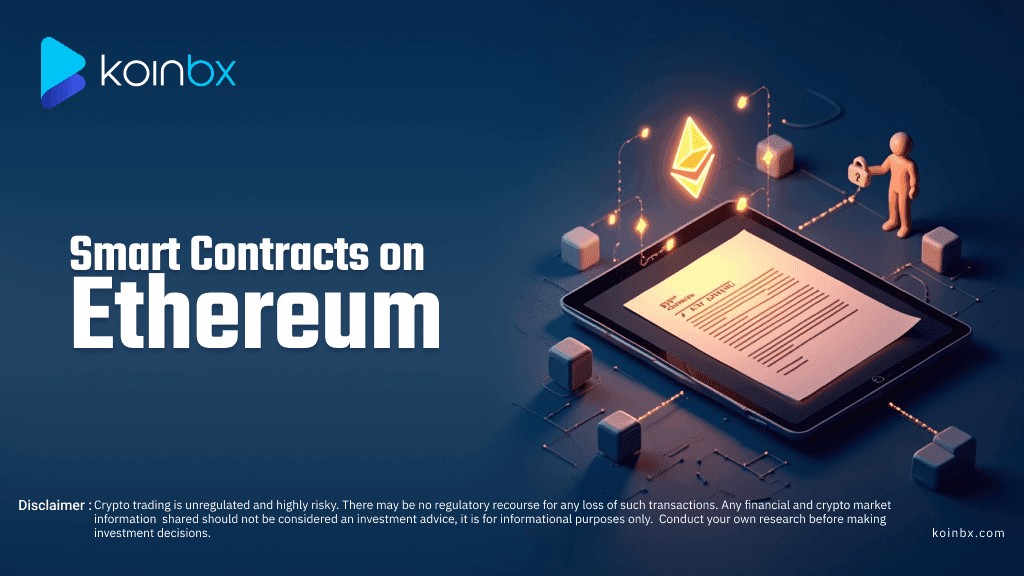
How Smart Contracts Work on Ethereum and Beyond
10/07/2025, 02:04:34 pm
Article Content
In this innovative digital era, smart contracts are another innovation. It changes the way we look at agreements and do transactions using the digital system. These create evolution and transform the industries from finance to supply chain management, which provides a safe, transparent, and efficient program.
Do you want to know more specifications about smart contracts? Let's explore how they work using their efficient tools and why it is essential in today’s blockchain ecosystem.
What Are Smart Contracts?
Smart contracts are digitalized programs that run automatically under certain predefined conditions when there is a specific condition to be met. It is comparable to a digital vending machine; when you enter the amount and select the item, the machine will automatically dispense your item without the need for any other external human intervention.
Unlike traditional contracts that rely on middlemen like banks, smart contracts operate on distinct blockchain networks. They employ codes that determine the rules and consequences of an agreement that is executed automatically when predetermined conditions are satisfied.
How Smart Contracts Function on Ethereum
Ethereum was the first platform to provide smart contracts to access a wide range of services. It provides a stable environment for its creation and implementation. They function within the Ethereum Virtual Machine (EVM), a runtime environment.
The Execution Process
A smart contract on Ethereum is given a distinct address on the blockchain upon deployment. By submitting transactions to its address, users can communicate with this contract. These transactions are then processed by the contract's code by its preprogrammed logic.
An amount of computational effort known as "gas" is used during each smart contract execution. In addition to ensuring network stability and preventing infinite loops, this gas system pays miners for processing transactions.
Key Features of Ethereum Smart Contracts
Ethereum smart contracts provide unique and useful tools for decentralized apps with a number of unique features.
Immutability: Once deployed, the code cannot be altered since it complies with the rules to maintain consistency and confidence.
Transparency: Anyone can view an auditable record of every transaction and contract code thanks to the blockchain.
Decentralization: There are no middlemen, and they are not governed by a single entity.
Deterministic Execution: Smart contracts provide identical outcomes and behave predictably.
Beyond Ethereum: Other Blockchain Platforms
Ethereum remains a popular platform for smart contracts even though several blockchains emerged with unique advantages and capabilities.
Binance Smart Chain
Binance Smart Chain provides faster transaction speeds and lower fees compared to Ethereum and attracts frequent interaction from applicants. It offers improved speed while remaining compatible with Ethereum's development tools.
Cardano
Cardano approaches smart contracts with formal verification, security, and research-driven processes, with which the platform allows the developer to write contracts with mathematical certainty about behavior.
Solana
Solana's blockchain is highly effective and can process thousands of transactions per second. It benefits applications that require continuous execution and can process contracts quickly with its proof-of-history consensus mechanism.
Polygon
Polygon is a layer-2 scaling solution that improves Ethereum's functionality by enabling cheaper and quicker transactions while preserving security via the main Ethereum network.
Real-World Applications
Smart contracts are being used in a wide range of industries due to their adaptability and impact.
Decentralized Finance (DeFi)
Smart contracts are used by DeFi protocols to generate financial services without the need for conventional middlemen. These apps make lending, borrowing, and trading easier by utilizing liquidity pools and automated market makers.
Supply Chain Management
Businesses use smart contracts for monitoring their goods right from producer to customer, guaranteeing authenticity and lowering fraud.
Digital Identity
Smart contracts give users control over their data and facilitate verification without disclosing private information. It is capable of managing and safeguarding digital identities in this way.
Insurance
When certain conditions are met, the insurance gets claimed automatically based on smart contracts. Payments are made more quickly and with lower administrative expenses.
Benefits and Considerations
The removal of middlemen, lower costs, and faster transactions are just a few benefits of smart contracts. In contract execution, they lower the possibility of human error and offer previously unheard-of transparency.
Users should be mindful of some factors, though. The underlying code of smart contracts determines their dependability, and errors can result in large losses. Additionally, once a contract is deployed, it is difficult to fix mistakes because contracts are immutable.
The Future of Smart Contracts
Smart contracts with their efficient features and tools are still evolving rapidly. Its cross-chain interoperability solutions bridge the communication between different blockchain networks. This builds the utility and the scope of contracts.
Blockchain innovation enhances the way in which the smart contract can be integrated into various aspects of daily life. It can create an efficient, trusted system; they are considered an important element in the decentralized future.
At KoinBX, we're committed to helping our users make sense of this ever-changing landscape and leverage smart contracts to advance their digital asset strategies.
Download KoinBX Android App | Download KoinBX iOS App
Disclaimer: Any financial and crypto market information shared should not be considered investment advice. It is for informational purposes only. Conduct your own research before making investment decisions. Crypto trading is unregulated and highly risky. There may be no regulatory recourse for any loss of such transactions.
Share Post
Share this article with your friends and community!