Loading…
Blog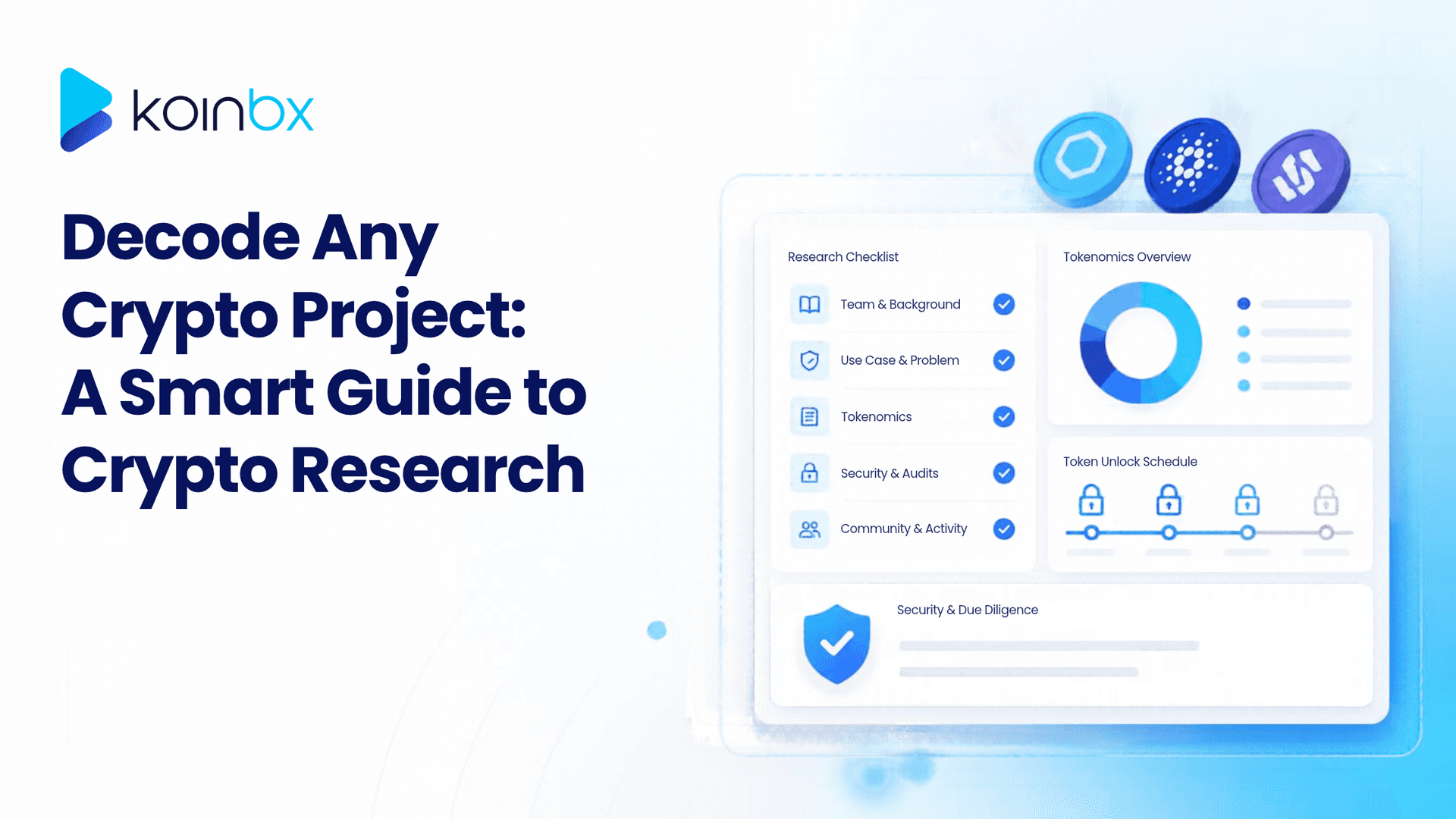
How to Research a Crypto Project Before Buying Its Token: A Beginner’s Guide
15/10/2026, 10:54:41 am
Article Content
How to Research a Crypto Project Before Buying Its Token: A Complete Beginner’s Guide
The cryptocurrency market offers thousands of digital assets, each claiming to solve a problem, introduce new technology or create opportunities for users. But how can you tell whether a crypto project has a useful purpose, a sustainable token model and a credible development team.
Looking at a token’s price, popularity or social media following is not enough. A project may attract attention without having a working product, while a technically promising project may still have risks related to token supply, security or liquidity.
Before buying a cryptocurrency, it is important to understand what the project does, why its token exists, how the token supply is distributed and what risks could affect its value.
In this guide, we will explain how to research a crypto project step by step, using practical checks that beginners can apply before making an informed decision.
1. Understand What the Crypto Project Actually Does
Start by understanding the project's purpose.
Visit its official website and read its documentation, whitepaper or technical overview. These materials should explain what the project aims to achieve, how it works and who it is designed to serve.
Ask yourself three basic questions:
- What problem does the project solve? Identify the specific problem it aims to address and why its proposed solution may be useful.
- How does the project work? Understand its underlying technology, main features and intended users.
- What has the project actually delivered? Check whether its product or network is live, under development or still at the proposal stage.
For example, a decentralised finance project may claim to let users lend and borrow digital assets without a traditional intermediary. Research whether the lending protocol is operational, which assets it supports and what risks users face.
Do not confuse a roadmap with an existing product. A feature described as a future development should not be treated as an available service.
It is also useful to compare the project's claims with independent evidence, such as publicly accessible product documentation, working applications, development activity and verifiable partnerships.
What to watch for: Vague descriptions, unrealistic promises, copied documentation or claims about partnerships that cannot be independently confirmed.
2. Research the Team and Project Transparency
A crypto project's credibility depends partly on the people and organisations responsible for developing and maintaining it.
Check the project's official documentation for information about its founders, developers, operating organisation and governance structure.
Look for:
- Team experience: Do the listed team members have relevant experience in technology, finance, cybersecurity or the project's industry?
- Previous work: Can you verify their professional backgrounds and earlier projects?
- Development activity: Is there evidence of ongoing development, updates or technical contributions where appropriate?
- Transparency: Does the project communicate product changes, security incidents and important decisions clearly?
- Governance: Who can make decisions about the protocol, change its rules or manage its treasury?
An anonymous team does not automatically mean a project is fraudulent, and a public team does not automatically make a project trustworthy. The objective is to understand the level of accountability and what evidence supports the project's claims.
Be cautious when a project relies heavily on celebrity endorsements, influencer promotions or claims of guaranteed profits instead of providing verifiable information.
3. Understand Tokenomics Before Buying
Tokenomics refers to the economic design of a cryptocurrency, including its supply, distribution, issuance, utility and mechanisms that may affect demand.
Understanding tokenomics helps you evaluate how tokens enter circulation, who controls them and what could influence their availability over time.
Circulating supply, total supply and maximum supply
These terms describe different aspects of a token's supply.
| Term | Meaning |
| Circulating supply | Tokens estimated to be available in the market and in circulation. |
| Total supply | Tokens that have been created, minus tokens permanently removed through burning, according to the relevant project's methodology. |
| Maximum supply | The maximum number of tokens that can exist, if the protocol or token design specifies a fixed limit. |
Not every cryptocurrency has a fixed maximum supply. Some allow additional issuance according to their protocol rules.
Why does supply matter?
Suppose a token has a circulating supply of 100 million tokens and a price of ₹10.
Its market capitalisation would be:
100 million × ₹10 = ₹1 billion.
Now suppose the circulating supply increases to 150 million tokens. If demand and all other factors remained unchanged, the additional supply could affect the price. In real markets, however, demand, liquidity, expectations and other factors also change, so supply alone cannot predict price movements.
When researching tokenomics, investigate:
- Whether the token has a fixed or flexible supply.
- Whether new tokens can be minted.
- Whether tokens can be burned and under what conditions.
- How tokens are allocated among the team, investors, community and treasury.
- Whether holders have governance rights, access to services or other clearly defined rights.
- Whether the token's stated utility creates a genuine reason for people to use it.
A project may have a useful product without its token necessarily capturing that product's value. Understand why the token is needed instead of assuming that the project's growth will automatically increase the token's price.
4. Check Token Unlocks and Vesting Schedules
Token unlocks are an important part of crypto research, particularly for projects that allocate tokens to founders, employees, early investors or ecosystem funds.
Some tokens are initially locked and released over time according to a vesting schedule. When previously restricted tokens become transferable, the amount available to the market may increase.
For example, imagine a project has 200 million tokens in circulation and plans to release another 50 million tokens from previously locked allocations.
If those tokens enter circulation, the circulating supply could increase to 250 million, assuming no other supply changes.
This does not mean the token's price will automatically fall. The effect depends on factors such as who receives the tokens, whether they sell, market demand, liquidity and what investors already expect.
How to research an upcoming unlock
- Find the project's official tokenomics documentation or vesting schedule.
- Identify the quantity of tokens scheduled for release and the expected date.
- Check who will receive the unlocked tokens, where that information is available.
- Compare the unlock quantity with the existing circulating supply.
- Investigate whether the schedule has changed and whether the release details can be independently verified.
A token unlock calendar can be a useful starting point, but verify its figures against the project's documentation and available on-chain information.
Key takeaway: An unlock is a potential change in token availability, not a reliable standalone signal that the price will rise or fall.
5. Evaluate the Token's Real Utility
A token's utility refers to what it actually enables users to do within a network, product or ecosystem.
Depending on the project, a token may be used for transaction fees, network participation, governance, access to services, staking or other purposes.
However, the presence of a stated use case does not automatically make a token valuable or necessary.
Consider these questions:
- Is the token already used in a functioning product?
- What activities require the token?
- Are users actually using those features?
- Can the same service operate without the token?
- Does the token provide clearly defined rights or functions?
- Is demand supported by real usage, or does it depend mainly on expectations of future price increases?
For example, a blockchain network may require its native token to pay transaction fees. Research the network's actual activity, fee mechanism and alternatives available to users.
A governance token may allow holders to vote on protocol proposals, but the extent of their influence depends on the project's governance rules and how voting power is distributed.
Also distinguish between current utility and planned utility. A feature described in a roadmap may never be launched, or its design may change.
6. Check Whether the Project Has Undergone a Security Audit
Security is particularly important for projects that use smart contracts, decentralised exchanges, lending protocols, bridges or other blockchain applications.
A smart contract is code deployed on a blockchain that executes according to its programmed rules. Errors or vulnerabilities can expose users and funds to significant risks.
A security audit is an assessment of a defined scope of code or system. It can help identify vulnerabilities, but it cannot guarantee that a project is completely secure.
What should you look for in an audit report?
The auditor: Check the identity of the auditing organisation and whether the report is available from a credible source.
The scope: Identify the contracts, code versions and components that were reviewed.
The date: An old audit may not cover later changes to the project.
The findings: Review the vulnerabilities identified, their severity and whether they were resolved or remain open.
The deployed code: Where verifiable information is available, check whether the deployed contracts correspond to the reviewed versions.
Upgrade permissions: Determine whether administrators can upgrade contracts or change important settings, and who controls those permissions.
A project may have undergone an audit and still face risks from newly introduced code, compromised administrative keys, external dependencies or governance decisions.
If the project claims to be audited but does not provide a verifiable report, treat the claim as unconfirmed until you can find supporting evidence.
7. Examine Trading Volume and Liquidity
Liquidity determines how easily a token can be bought or sold without significantly affecting its market price.
A token may display a high market capitalisation but still have limited liquidity. This can make it difficult to execute larger orders at the expected price.
Two important metrics are trading volume and market depth.
Trading volume
Trading volume measures the amount of trading activity over a specified period.
Compare volume across relevant trading pairs and exchanges. Check whether the activity is consistent and whether the data source provides a clear methodology.
High reported volume alone does not prove that a market is deep or that every trade can be executed efficiently.
Market depth
Market depth shows the buy and sell orders available at different price levels in an order book. In decentralised markets, relevant measures may also include liquidity available in trading pools.
A market with limited depth may experience greater price movement when a large order is placed.
The bid-ask spread
The bid-ask spread is the difference between the highest available buy price and the lowest available sell price.
A narrower spread often indicates a more competitive market at that moment, while a wider spread may indicate lower liquidity or greater uncertainty. The spread can change quickly.
Practical liquidity checks
Before considering a token, investigate:
- Where it is traded and which trading pairs are available.
- Whether reported trading volume is consistent across reliable sources.
- The available market depth relative to the size of an order you might place.
- The bid-ask spread and potential slippage.
- Whether decentralised liquidity pools have sufficient depth and what risks those pools carry.
Remember that liquidity can change suddenly. A token that is easy to trade today may become harder to sell during market stress.
8. Verify the Token's Contract Address
Token names, symbols and logos can be copied. A token that uses the same name as a well-known project may be an imitation.
If you are researching a token on a blockchain that uses smart contracts, verify its contract address using the project's official documentation and the relevant blockchain explorer.
Check that:
- The contract address matches the address published through a reliable official channel.
- The token is on the correct blockchain network.
- The available contract information is consistent with the project's claims.
- The contract's permissions and administrative controls are understood, where applicable.
- The token's identity is confirmed before interacting with it or sending funds.
Do not rely solely on search results, social media posts or direct messages to identify a token. An incorrect contract address can lead to buying an unrelated asset or interacting with a malicious contract.
Native blockchain coins may not use token contract addresses in the same way as smart-contract tokens, so the verification method depends on the asset and network.
9. Look for Red Flags Before Making a Decision
No single warning sign proves that a crypto project is fraudulent. However, several unresolved concerns together may justify further investigation or avoiding the project.
Be cautious when you encounter:
- Guaranteed returns: Claims that an investment cannot lose money or will deliver a fixed profit.
- Unclear tokenomics: Missing supply information, unexplained allocations or contradictory figures.
- Unverifiable claims: Partnerships, team credentials or product milestones that cannot be independently confirmed.
- Unresolved security concerns: Serious audit findings, unclear administrative controls or undisclosed security incidents.
- Limited liquidity: Markets where even modest orders may cause substantial price changes.
- Unclear token utility: A token whose purpose and role in the project cannot be explained.
- Pressure to buy immediately: Promotions that create urgency without giving readers time to verify the information.
- Impersonation risks: Fake websites, cloned tokens, suspicious links or individuals claiming to represent the project.
A polished website, large social media following, exchange listing or completed audit is not proof that a token is safe or will increase in value.
10. Use a Crypto Research Checklist
Before making a decision, use the following checklist to organise your research.
- I understand what the project does and what problem it aims to solve.
- I have checked the project's official documentation and verified important claims where possible.
- I understand the token's utility and the rights it actually provides.
- I have reviewed circulating supply, total supply and maximum supply, where applicable.
- I have checked token allocations, vesting and upcoming unlocks.
- I have investigated available security audits and unresolved findings.
- I understand the token's contract address or relevant asset identifier.
- I have reviewed trading volume, market depth, spread and potential slippage.
- I have considered team transparency, governance and administrative controls.
- I have identified the major risks and considered what could make the project fail.
- I am not relying on guaranteed-return claims, influencer promotions or short-term price movements as the basis for my decision.
If you cannot verify an important detail, record it as unknown rather than assuming the best-case scenario.
Frequently Asked Questions
Does a lower-priced cryptocurrency have more growth potential?
Not necessarily. The price of one token does not tell you whether the project is undervalued. Supply, market capitalisation, demand, token distribution and the project's underlying economics all matter.
Does a security audit mean a crypto project is safe?
No. An audit assesses a particular scope of code or system at a particular point in time. It may not cover later changes, every vulnerability, operational risks or the project's economic design.
Are token unlocks always bearish?
No. Unlocks increase the quantity of tokens that may become available, but the market impact depends on demand, liquidity, recipient behaviour and expectations already reflected in the price.
Is high trading volume enough to establish that a token is liquid?
No. Trading volume should be assessed alongside market depth, spreads, slippage and the reliability of the underlying data.
Can research predict a token's future price?
Research can help you understand a project's fundamentals, risks and market conditions, but it cannot reliably predict every price movement or guarantee a profitable outcome.
Final Thoughts
Researching a crypto project involves more than checking its price chart or reading its promotional material. It requires understanding what the project does, why its token exists, how its supply is managed, whether its technology has been reviewed and how easily the token can be traded.
Tokenomics, unlock schedules, utility, security audits and liquidity each reveal a different part of the picture. None should be considered in isolation.
The goal of research is not to prove that a token will rise in value. It is to understand the available evidence, identify potential risks and make a more informed decision.
Disclaimer:
This article is for educational purposes only and is not financial or investment advice. Cryptocurrency assets are volatile and may result in partial or total loss of capital. Conduct independent research and consider your financial circumstances before making investment decisions.
Terms & Conditions
By accessing or using KoinBX services, you agree to comply with KoinBX’s applicable Terms & Conditions, policies, eligibility requirements and product-specific terms. Product availability, features, fees and conditions may vary by jurisdiction and may be subject to change.
Risk Disclaimer
Crypto assets and crypto-related products are highly volatile and involve significant risk. Futures and leveraged trading can result in substantial losses, including loss of your entire invested capital. Please assess your risk tolerance, understand the product and applicable terms, and trade responsibly. Do not invest or trade more than you can afford to lose.
Share Post
Share this article with your friends and community!